No-Logs VPN Audits, Explained Without the Marketing Fog
A friendly explanation of no-logs VPN audits, what they prove, what they do not prove, and how iPhone users should read privacy claims.
Quick Answer
A no-logs VPN audit can make a logging claim more credible, but it does not mean the VPN collects nothing or protects every part of privacy. Users should still ask what was audited, when it happened, and what data the VPN says it does not collect.
Best For
Search Intent
The reader wants to understand whether a no-logs audit should increase trust.
Shareable Angle
No-logs is not a magic phrase. The useful question is: no logs of what?
If you have compared VPN apps, you have probably seen the phrase “no-logs VPN.” You may also see some VPNs mention an audit.
That sounds serious, but it can be hard to understand.
What does a no-logs VPN audit actually mean? Does it mean the VPN collects nothing? Does it mean you are completely anonymous? Does it mean you never need to think about privacy again?
Not exactly.
The Simple Answer
A no-logs audit usually means an outside reviewer checked whether a VPN’s systems and policies match its logging claims.
That can be useful. It can make a privacy claim more credible than a slogan on a homepage.
But an audit is not magic. It depends on what was audited, when it was audited, how detailed the report was, and what the VPN promised in the first place.
For regular iPhone users, the key is simple: do not just look for the phrase “no logs.” Look for a clear explanation of what is not collected.
Why “No Logs” Confuses People
The phrase “no logs” sounds like it means “no data at all.”
In real products, it is usually more specific. A VPN may still need some service data to operate, such as:
- Account information
- Payment status
- Device count
- Plan usage
- Diagnostics
- Support messages
- Abuse prevention signals
That does not automatically make the VPN unsafe. Many services need basic operational data.
The important issue is whether the VPN collects sensitive browsing-related data, such as browsing history, visited URLs, DNS query details, or raw traffic content.
Those are the details users actually care about.
What An Audit Can Help With
An audit can help answer questions like:
- Does the VPN’s technical setup match its privacy claims?
- Are logging systems configured the way the company says?
- Are there obvious mismatches between policy and infrastructure?
- Does the company have controls around sensitive data?
This is useful because trust should not depend only on nice copywriting.
Still, audits vary. Some are broad. Some are narrow. Some publish detailed summaries. Some publish very little. Some are recent. Some are years old.
If a VPN mentions an audit but gives no detail, users still have to guess.
What An Audit Does Not Prove
A VPN audit does not mean:
- The VPN protects every part of your privacy
- You can safely click phishing links
- Every future version will work the same way forever
- The company collects no service data at all
- Your iPhone apps cannot collect their own data
- You are anonymous in every situation
That last point matters. A VPN can protect the connection layer, but it does not control what you type, which accounts you log into, what websites collect, or what apps do inside their own systems.
So when a VPN sells “total privacy,” be careful. Honest limits are a sign of a more mature product.
How A Normal User Should Read A VPN Privacy Claim
You do not need to read every technical document. Start with practical questions:
- Does the VPN clearly say whether it collects browsing history?
- Does it clearly say whether it stores visited URLs?
- Does it mention DNS query details?
- Does it explain raw traffic content?
- Does it say what service data may still be used?
- Does the App Store privacy information match the policy?
If the answer is “I cannot tell,” that is not ideal.
Good privacy communication should be understandable without a law degree.
A Real Example Of User Confusion
Say you are at a hotel and want to use Wi-Fi on your iPhone. You open the App Store and compare VPN apps.
One app says “100% anonymous forever.”
Another says “no logs.”
A third says, “We do not collect browsing history, visited URLs, DNS query details, or raw traffic content.”
The third statement is less flashy, but it is more useful. It tells you exactly what the product is not collecting. It also leaves room for honest explanation of account, usage, purchase, support, or diagnostic data.
That is the kind of clarity people can actually use.
Why Clear Usage Also Matters
Privacy is not only about what a VPN does not collect. It is also about whether the user understands the service.
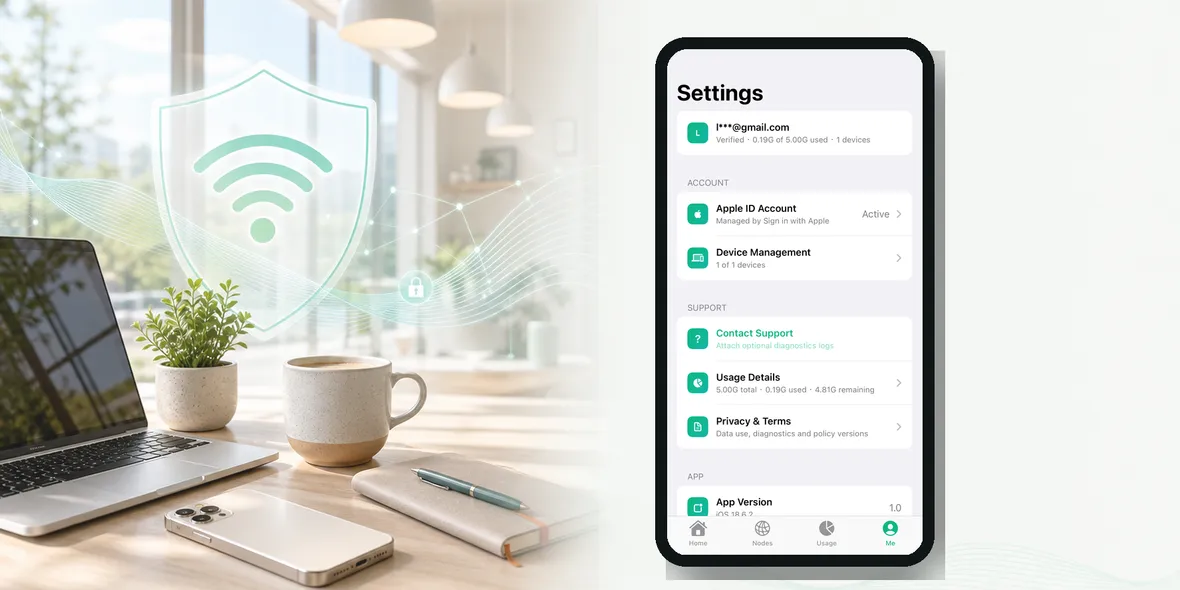
If your VPN plan has limits, you should see them clearly. If your current cycle has used data, you should not have to guess. If the app has official server locations, they should be understandable.
Confusing interfaces create distrust. Clear interfaces reduce the mental load.
Where Sovatun Fits
Sovatun takes the plain-language approach. It is built for iPhone users who want a simple private tunnel for public Wi-Fi, official locations, and visible usage.
Sovatun does not collect browsing history, visited URLs, DNS query details, or raw traffic content. That is the privacy boundary users should be able to understand quickly.
It is not a promise that a VPN solves every privacy issue. It is a clear statement about what Sovatun does not collect while helping protect the connection layer on shared networks.
Use Sovatun when you want transparent usage and clear data boundaries.
Bottom Line
A no-logs audit can be a good sign, but it should not be the only thing you look at.
Look for plain explanations, recent information, realistic claims, and clear product behavior.
The best privacy language is not the loudest. It is the easiest to understand.
Quick Questions
Does no-logs mean a VPN collects no data at all?
Usually no. A VPN may still need account, purchase, support, diagnostics, usage, device, or abuse-prevention data. The important question is whether it collects browsing-related data.
What does Sovatun say it does not collect?
Sovatun does not collect browsing history, visited URLs, DNS query details, or raw traffic content.
Does an audit prove future versions will never change?
No. An audit reflects a scope and moment in time. Users should still look for clear current policies, App Store privacy details, and honest product wording.