Sovatun VPN For iPhone: Simple Protection For Public Wi-Fi
A clear introduction to Sovatun VPN for iPhone users who want public Wi-Fi protection, official locations, and transparent usage.
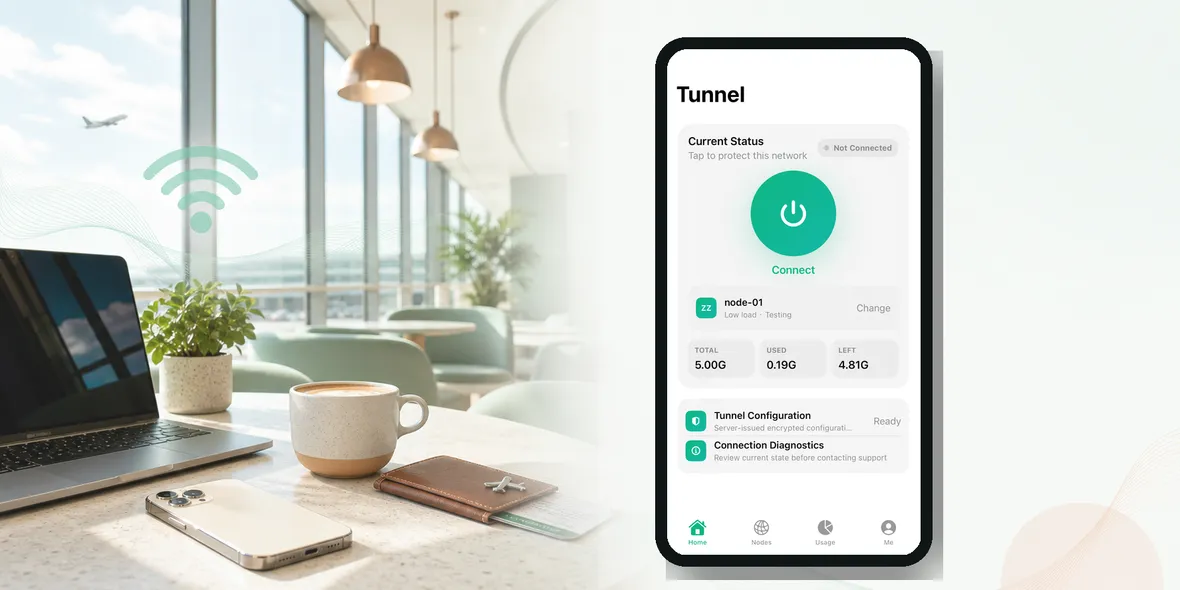
Quick Answer
Sovatun is a download-and-use iPhone VPN for everyday public Wi-Fi and travel. It focuses on connection-layer protection, official locations built into the app, clear usage, and privacy wording that avoids exaggerated anonymity claims.
Best For
Search Intent
The reader wants to understand what Sovatun is and whether it matches their VPN use case.
Shareable Angle
Sovatun is not trying to be a giant VPN suite. It is trying to be understandable.
The answer is not only about features. It is about whether a normal iPhone user can understand the product before relying on it.
The product fits ordinary moments: airport Wi-Fi, hotel Wi-Fi, cafe Wi-Fi, campus Wi-Fi, train station Wi-Fi, shared office Wi-Fi, and family travel networks.
Why This Feature Matters
VPNs can feel invisible. You tap connect, something happens in the background, and then you continue browsing. That is exactly why clarity matters. Users should not have to guess what is active, what location they selected, how much usage remains, or what privacy statement applies.
A clear product reduces hesitation. If the user understands the app in one minute, they are more likely to use it at the moment it matters: before browsing on public Wi-Fi.
What A Good VPN Should Make Easy
A good everyday VPN should make these things easy to see or understand:
- Turn it on before public Wi-Fi browsing
- Choose an official location
- Watch usage clearly
- Use trusted apps and websites
- Keep account safety habits in place
These details are not decoration. They help users make better decisions in real life, especially when they are traveling, studying, working remotely, or using shared Wi-Fi between tasks.
Where Users Get Let Down
Many VPN products overfocus on big claims and underexplain daily use. That creates confusion.
Watch out for:
- expecting a VPN to solve every privacy problem
- ignoring fake Wi-Fi signs
- using suspicious links
- turning off two-factor authentication
- choosing products by hype alone
The problem is not that marketing exists. The problem is when marketing replaces the information users need to choose responsibly.
How This Looks In Real Use
Imagine opening your iPhone in a hotel or airport. You do not want to read a technical manual. You want to know whether the VPN is connected, which location is selected, and whether your current usage is still okay.
That is the kind of product detail that makes a VPN usable, not just impressive on a landing page.
Honest Privacy Wording
Sovatun does not collect browsing history, visited URLs, DNS query details, or raw traffic content. That statement is more useful than broad claims like total anonymity because it tells users what is not collected.
A VPN still does not replace strong passwords, two-factor authentication, careful links, or trustworthy apps. It helps with the connection layer on shared networks.
Where Sovatun Fits
Sovatun focuses on simple iPhone controls, official locations, clear usage, and plain privacy boundaries. It is built for everyday public Wi-Fi moments rather than complicated power-user workflows.
Use Sovatun as a simple, transparent iPhone VPN for public Wi-Fi and travel.
Bottom Line
The best VPN feature is not always the biggest claim. Often it is the detail that helps a user feel oriented: clear status, clear usage, clear locations, and clear data boundaries.
How This Feature Helps In Daily Use
A feature is only useful if people understand it at the moment they need it. For “Sovatun VPN For iPhone: Simple Protection For Public Wi-Fi”, the value is not just what the app can technically do. The value is whether a user can make a confident decision quickly.
Think about a traveler in a hotel lobby, a student in a library, or a remote worker in a cafe. They are not reading documentation. They are glancing at the screen and asking: am I connected, what am I using, and can I continue?
That is why Sovatun’s product direction should stay simple. Clear status, clear usage, clear locations, and clear privacy wording reduce hesitation. Users should not feel trapped inside a VPN app they do not understand.
What A User Should Be Able To Tell Immediately
A good iPhone VPN experience should answer these questions fast:
- Is the VPN connected or not?
- Which official location or node am I using?
- How much usage have I used this cycle?
- How much is left?
- What does the service say it does not collect?
If those answers are hidden, the product may feel powerful but not trustworthy.
The Better Brand Promise
The stronger promise is not “we do everything.” The stronger promise is “we explain the important parts clearly.”
Sovatun should keep saying what it actually does: a simple private tunnel for iPhone public Wi-Fi browsing, transparent usage, official locations, and no collection of browsing history, visited URLs, DNS query details, or raw traffic content.
Quick Questions
What is Sovatun VPN?
Sovatun is an iPhone VPN app focused on public Wi-Fi, travel browsing, official locations, clear usage, and simple setup.
Does Sovatun support imported VPN configurations?
Sovatun is positioned around official locations built into the app, not user-imported external VPN configurations.
What privacy claim does Sovatun make?
Sovatun says it does not collect browsing history, visited URLs, DNS query details, or raw traffic content.